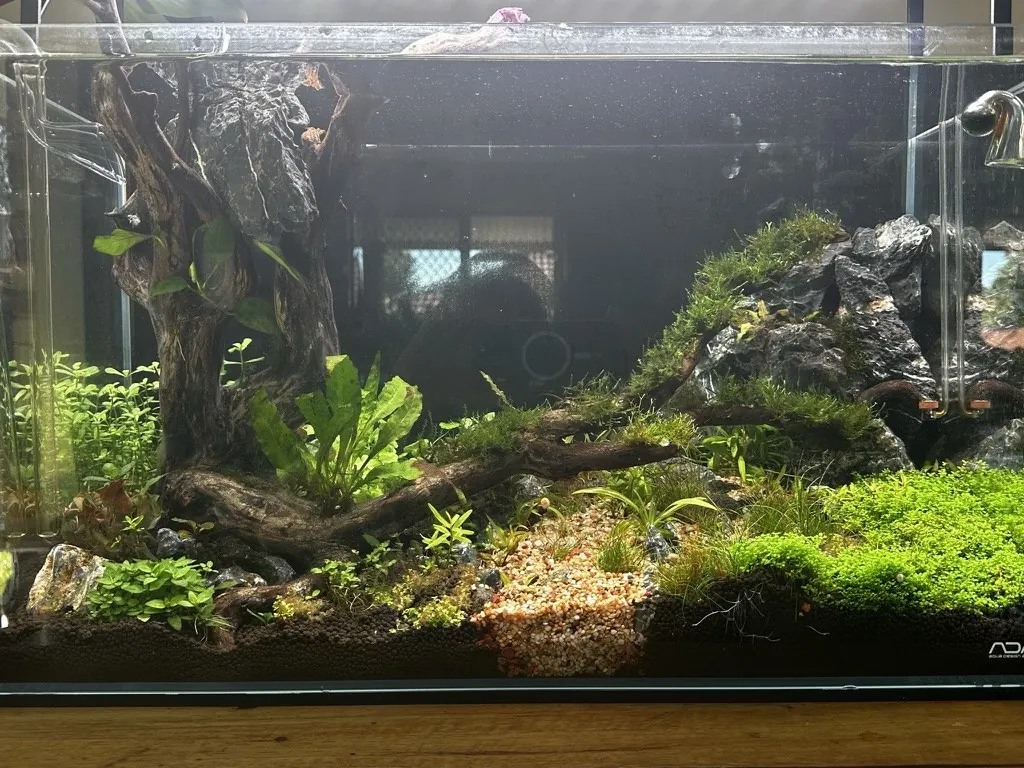
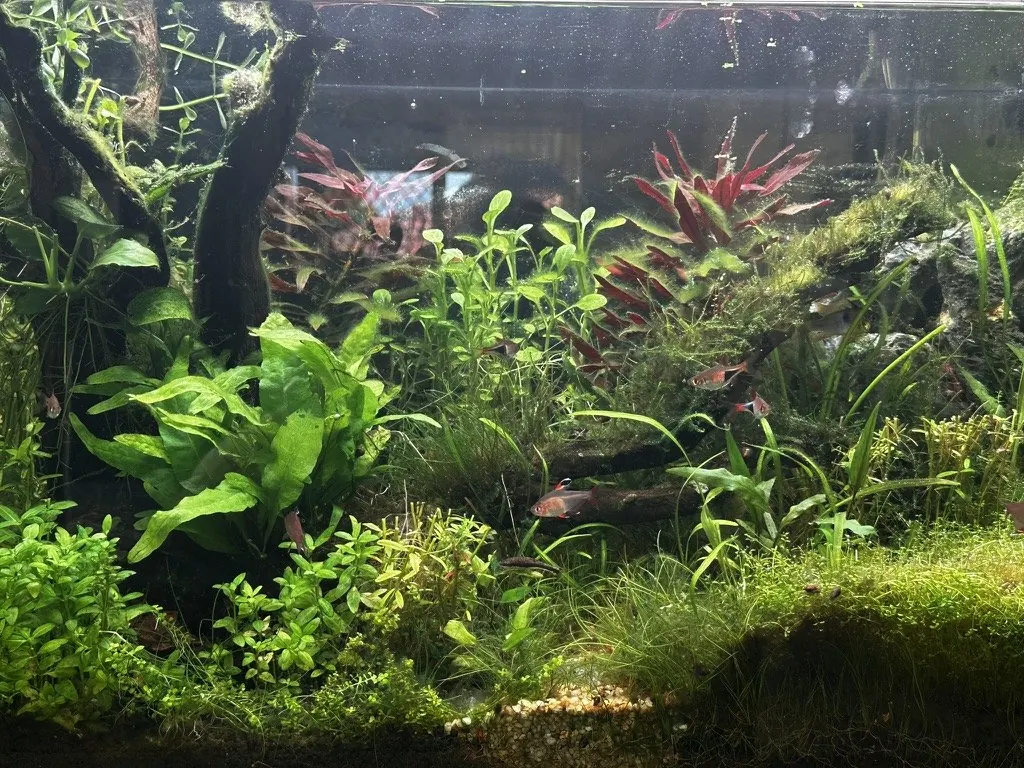
If you’re reading this, chances are you already run a planted tank and you’re weighing up pressurised CO2 — or you’ve got a system and want it running sweeter. I keep and aquascape planted tanks at home, so I’ll skip the “what’s a plant” part. CO2 is the single biggest lever on how a scape grows — and the one that’ll harm your livestock fastest if you get it wrong. So it’s worth doing deliberately.
What CO2 actually does
Carbon is a macronutrient, and in most tanks it’s the limiting one — the short stave in the barrel. You can be dosing perfect ferts under strong light and still get sulky, slow growth because the plants have run out of carbon by mid-morning. Add a stable supply and everything else you were already giving them finally gets used: faster, denser, better-coloured growth, and paradoxically less algae, because healthy plants outcompete it for nutrients.
The catch is that CO2 raises the ceiling on light, too. Turn the lights up without matching CO2 and you don’t get more plant — you get algae filling the gap. Light, CO2 and nutrients are a three-legged stool; CO2 just lets the other two legs grow longer.
The kit, and what each part is doing
- Cylinder + regulator with a solenoid — the solenoid is what lets a timer switch the gas on and off. A dual-stage (or a genuinely good single-stage) regulator matters more than people admit: it’s your insurance against the “end-of-tank dump”.
- Needle valve + bubble counter — to meter and eyeball the rate. Bubble count is a starting gauge, not a target; two diffusers can turn the same bubble rate into very different dissolved CO2.
- Diffuser or inline reactor — how you actually dissolve it. Reactors are near-100% efficient and mist-free; ceramic diffusers are simpler but clog and drift over time.
- Drop checker — a slow visual readout of dissolved CO2. Fill it with 4 dKH reference solution, not tank water, or the colour means nothing.
- (Optional) pH controller — useful, but a crutch if you trust it blindly. More on that below.
Dialling it in
The working target is around 30 ppm dissolved — enough to satisfy the plants, below where most fish struggle. Three ways to read it, in increasing order of trust:
- Drop checker lime-green = roughly 30 ppm — but it lags by an hour or more, so it’s telling you about the past, not this minute.
- pH swing: a drop of about 1.0 pH from fully degassed water corresponds to roughly a 30× rise in CO2 — a far more responsive gauge than the drop checker.
- The livestock — the only reading that actually matters. More on that next.
Run the gas on a timer: on 1–2 hours before the lights so the tank is at target when photosynthesis starts, and off about an hour before lights-out so you’re not gassing the tank into the night. Raise the rate slowly over days, watching the fish each time — never chase a number in one go.
CO2 doesn’t grow plants for you — it lets the light and nutrients you’re already giving them finally get used.
Livestock come first
Too much CO2 suffocates — it drops the pH and eats into the oxygen your fish and shrimp can actually use. The tell is behaviour, not a meter: fish hanging at the surface or gasping at the outflow means it’s too high, now — cut the gas and get air in. Strong surface agitation (or an air stone on a night timer) offloads CO2 and re-oxygenates overnight, which is exactly when you want it gone.
Shrimp are hardier on absolute pH than their reputation suggests, but they loathe rapid swings — so ramp any change over days and keep it stable. That’s the whole game with a shrimp tank on CO2: steady, moderate, and well-oxygenated at night. A simple solenoid on a reliable timer does more for livestock safety than any single gadget.
Light and ferts have to keep up
Because CO2 lifts the ceiling, light and nutrients become the next limits. High light over weak or patchy CO2 is the classic recipe for an algae farm. If algae shows up after you add gas, the fix is almost always better CO2 distribution and a touch less light — not another bottle of additive. Dose ferts to match the growth you’re now getting, keep flow reaching every corner, and stay on top of maintenance.
Where high-tech tanks actually go wrong
- End-of-tank dump — a tiring single-stage regulator can release a slug of CO2 as the cylinder empties, overnight, all at once. Dual-stage gear and a habit of watching cylinder pressure are the guard.
- Gas left on overnight — no photosynthesis to use it, plunging pH, gasping fish by morning.
- Drop-checker lag — trusting a reading that’s an hour stale and over-cranking the gas.
- A clogging diffuser — ceramic discs quietly lose output; your ppm falls and the tank slides without an obvious cause.
- Blind faith in a pH controller — a probe drifts out of calibration and happily holds the wrong number. The experienced move is to watch the animals, not just the display.
Leaving a high-tech tank with a sitter
A CO2 tank is more to hand over than a low-tech one — but it’s very doable with a proper brief, and it’s exactly the kind of setup I’m comfortable minding. Before you travel, the things worth me knowing are: where the CO2 shutoff and cylinder pressure gauge are; the timer schedule; what the drop checker should look like; where the top-up or auto top-up sits; and above all, what wrong looks like on your tank — fish at the surface means CO2 is too high: kill the gas, add air. If the cylinder’s near empty when you leave, I’d rather swap it or run lean than risk an end-of-tank dump while you’re away. The point is simple: you can head off and leave a high-tech scape with someone who understands the system, not just someone who’ll drop food in.
A few of my own tanks
The kind of growth and detail a well-run planted tank can hold. Tap any photo to enlarge.
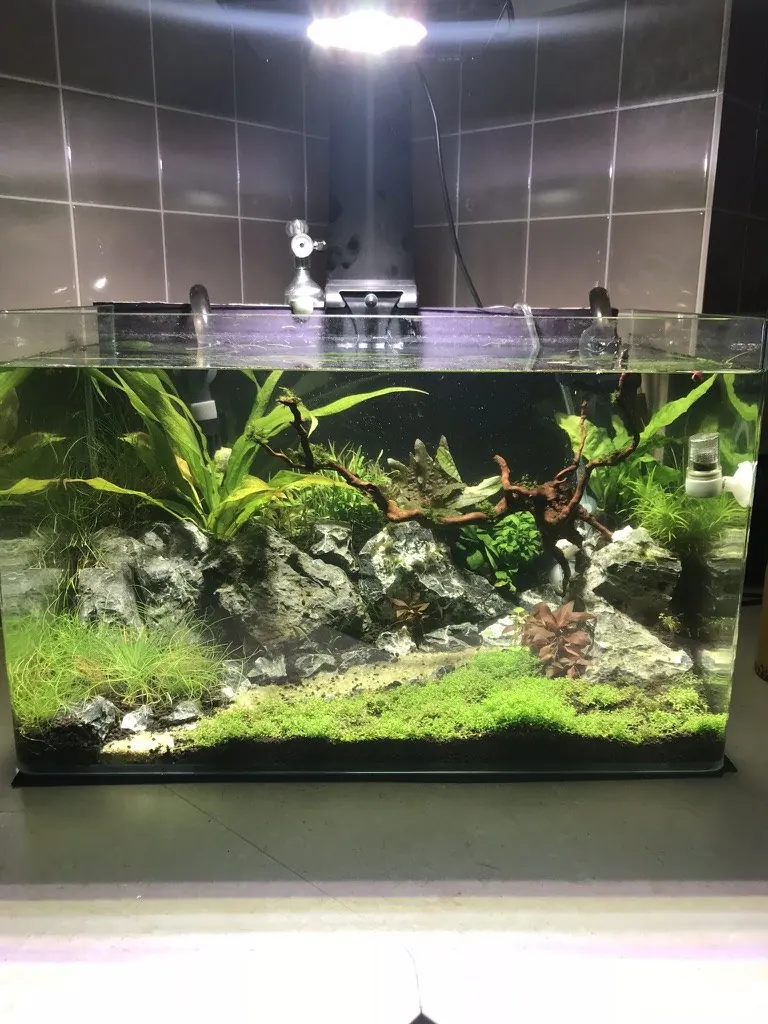
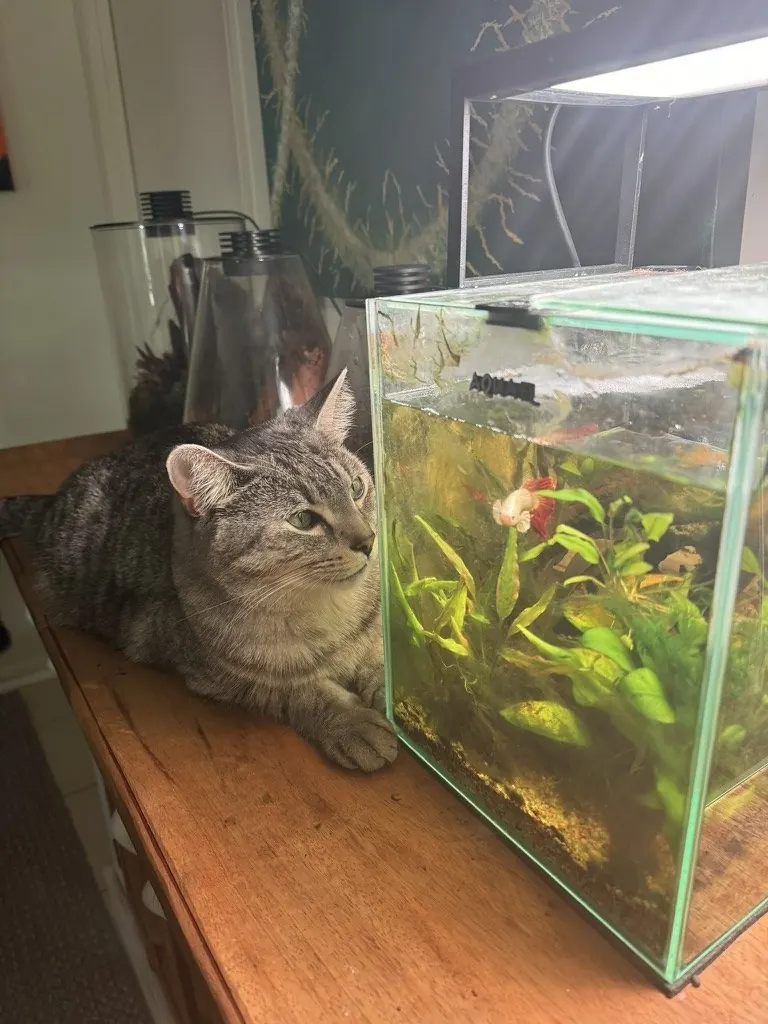
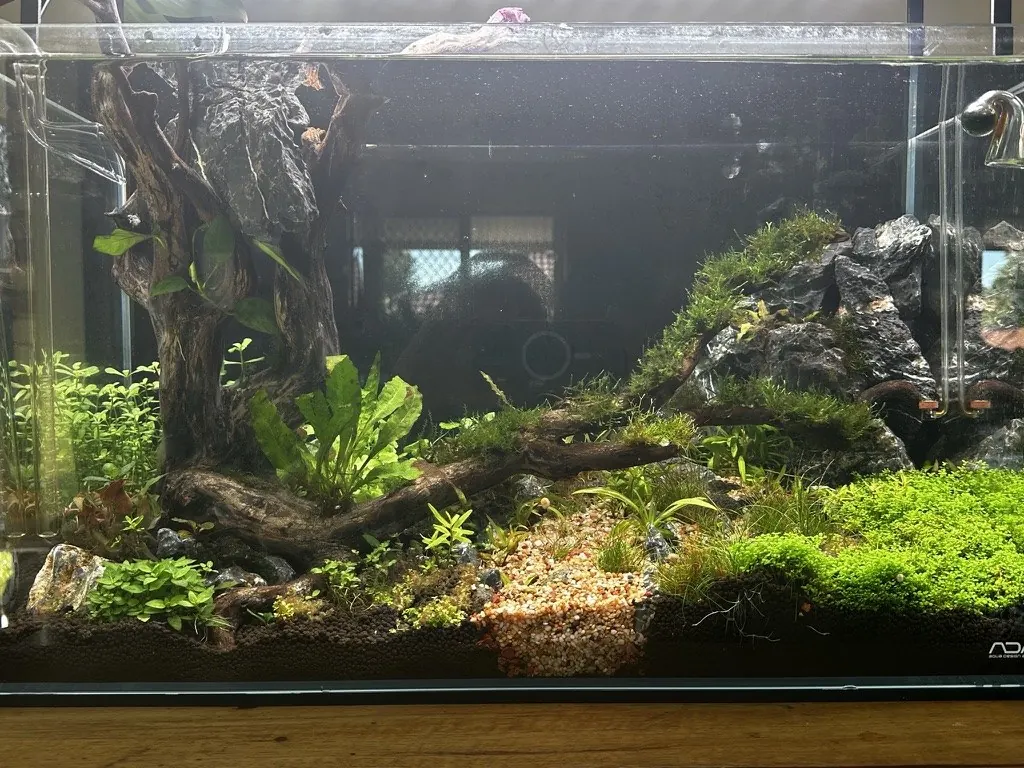
None of this is magic — it’s balance, and a bit of respect for how much CO2 can do in both directions. Get it dialled and a planted tank is the most rewarding thing in the house; get it wrong and it’s the fastest way to lose a tank of fish overnight. Start conservative, move in small steps, and always let the livestock have the final say.
Fish, reptiles & exotics
The pets others won’t take.
Aquariums, reptiles, birds and small pets — I’m happy with the animals a lot of sitters turn away. Book a free meet & greet across Western Brisbane & Ipswich.
Book a meet & greet